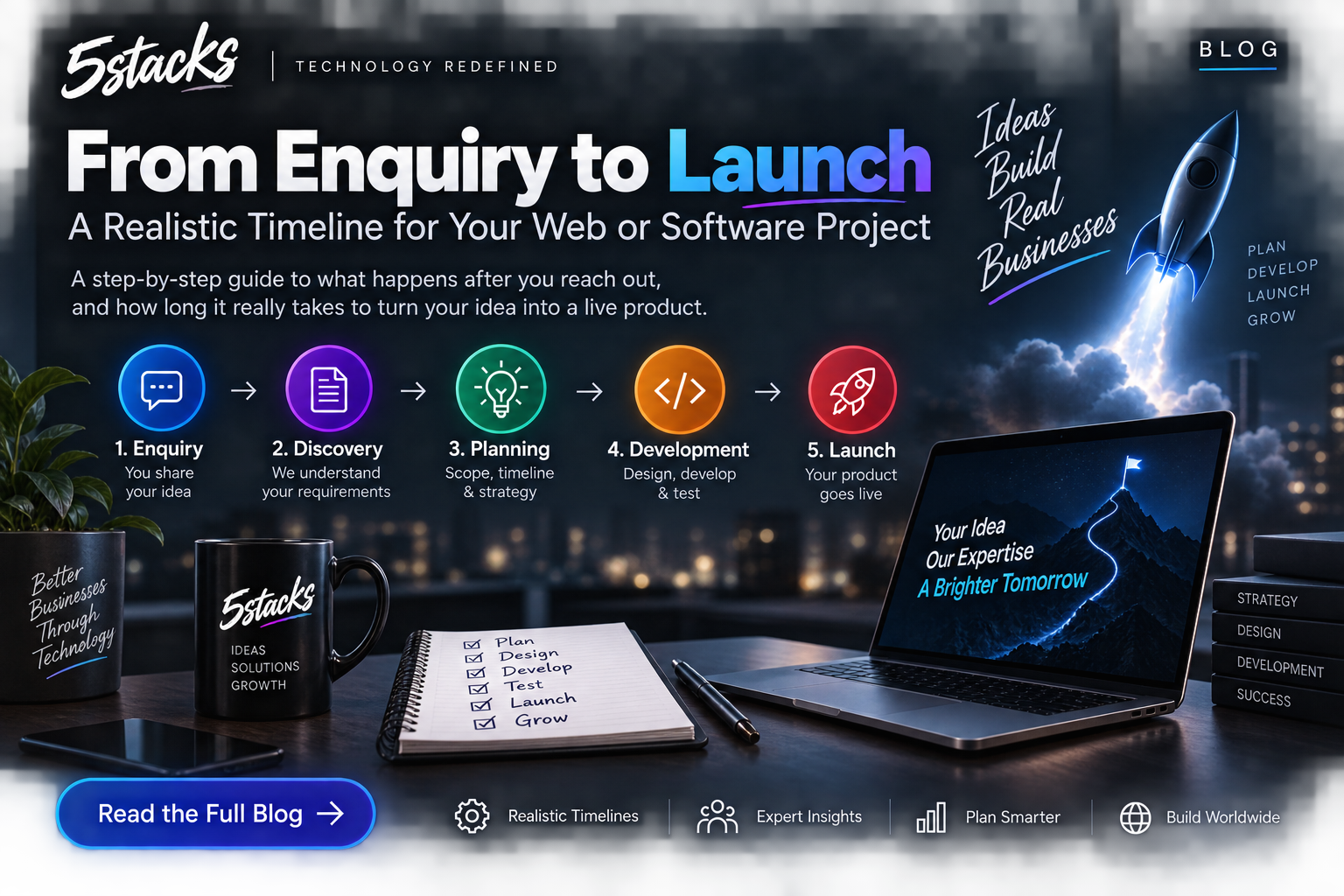
From Enquiry to Launch: A Realistic Timeline for Web and Software Projects
“How long will it take?” depends on scope and decisions. Visual timelines for In...


The SaaS landscape is perpetually evolving, driven by an insatiable demand for efficiency, personalization, and intelligence. In this dynamic environment, AI in SaaS product development is no longer a futuristic concept but a present imperative. For SaaS founders, startups, developers, and business owners across the globe, including the burgeoning market in India, understanding and strategically integrating Artificial intelligence (AI) is crucial for sustained growth and competitive advantage.
This comprehensive guide delves into the transformative power of AI, exploring how it can redefine your product, enhance user satisfaction, and optimize operations. We'll provide actionable insights for both strategic decision-makers and hands-on developers, helping you navigate the complexities and unlock the immense potential of AI in your SaaS journey.
AI is more than just a buzzword; it's a fundamental shift in how software interacts with data, users, and business processes. For SaaS products, this translates into unprecedented opportunities to create more intelligent, adaptive, and valuable solutions. From automating mundane tasks to delivering hyper-personalized experiences, the impact of AI in SaaS product development is far-reaching and profound.
The modern user expects not just functionality, but intelligence. They want products that anticipate their needs, learn from their behavior, and seamlessly integrate into their workflows. AI fulfills this expectation by enabling systems to analyze vast datasets, recognize patterns, make predictions, and even generate content or decisions without explicit programming for every scenario.
One of the most immediate and impactful applications of AI in SaaS is the enhancement of the user experience. AI allows products to move beyond one-size-fits-all approaches, offering truly personalized interactions. Imagine a CRM that not only stores customer data but actively suggests the next best action based on past interactions, market trends, and customer sentiment. Or an e-learning platform that adapts its curriculum in real-time to a student's learning pace and preferred style.
This level of personalization fosters a deeper connection with the product, making it indispensable to the user's daily operations.
Beyond the user-facing aspects, AI revolutionizes the backend operations of SaaS products, leading to significant gains in efficiency and cost reduction. Automation, powered by AI, can take over repetitive, time-consuming tasks, freeing up valuable human resources to focus on strategic initiatives.
By making operations smarter and more autonomous, AI not only cuts costs but also improves the speed and quality of service delivery, directly impacting customer satisfaction and operational scalability.
Perhaps the most exciting aspect of AI in SaaS product development is its ability to foster genuine innovation and carve out a distinct competitive edge. AI enables the creation of entirely new features and capabilities that were previously impossible, transforming how problems are solved.
In a crowded market, AI can be the differentiator that propels a SaaS product from merely functional to truly indispensable.
Successfully integrating AI requires identifying the right opportunities within your product's ecosystem. Here are some critical areas where AI can deliver significant value:
This involves using AI to automate tasks that require some level of 'intelligence' or decision-making. Beyond simple rules-based automation, intelligent automation leverages machine learning to adapt and improve over time.
AI excels at processing and interpreting vast quantities of data to uncover hidden patterns and provide actionable insights that would be impossible for humans to discover manually.
NLP allows machines to understand, interpret, and generate human language, opening up a wealth of possibilities for user interaction and data analysis.
For SaaS products dealing with visual data, computer vision AI can unlock powerful new capabilities.
For SaaS founders and business owners, the journey into AI integration requires a clear strategy that aligns technological ambition with business objectives.
Don't implement AI for AI's sake. Start by identifying specific pain points or opportunities within your product or operations where AI can deliver measurable value. Begin with small, manageable projects that can demonstrate quick wins before scaling.
AI models are only as good as the data they are trained on. Prioritize collecting high-quality, relevant, and sufficiently large datasets. Establish robust data governance policies, ensuring data accuracy, privacy, and accessibility. Without a strong data foundation, even the most sophisticated AI models will underperform.
Evaluate open-source frameworks (TensorFlow, PyTorch) against proprietary solutions and cloud AI services (AWS SageMaker, Google AI Platform, Azure ML). The choice depends on your team's expertise, budget, scalability needs, and the complexity of your AI requirements. Leveraging cloud AI services can significantly accelerate development and reduce infrastructure overhead.
Deciding whether to build an in-house AI team or partner with an experienced development firm is a critical decision. Building an AI team requires significant investment in talent, infrastructure, and ongoing research. Partnering with a specialist like 5Stacks can provide access to immediate expertise, accelerate your time-to-market, and ensure best practices in AI development and deployment. We specialize in crafting intelligent, scalable SaaS solutions tailored to your unique business needs.
Adopt an agile, iterative approach to AI development. Start with a Minimum Viable Product (MVP) and continuously refine your models based on performance data and user feedback. Crucially, embed ethical AI principles from the outset. Consider data privacy, algorithmic bias, transparency, and accountability to build trust and ensure responsible innovation.
For the technical minds driving the product, implementing AI involves specific skill sets and best practices.
Invest in continuous learning for your development team. Proficiency in popular AI/ML frameworks like TensorFlow, PyTorch, scikit-learn, and programming languages like Python is essential. Understanding core machine learning concepts, including supervised, unsupervised, and reinforcement learning, is foundational.
Modern cloud platforms offer powerful, pre-built AI services and managed machine learning environments. Services like AWS SageMaker, Google Cloud AI Platform, Azure Machine Learning, and IBM Watson can significantly reduce the complexity and time required for model training, deployment, and management. They allow developers to focus on problem-solving rather than infrastructure.
Robust data engineering is paramount. Ensure clean, well-structured data pipelines for ingesting, transforming, and feeding data to your AI models. Implement MLOps (Machine Learning Operations) practices to streamline the entire AI lifecycle, including model versioning, continuous integration/continuous deployment (CI/CD) for models, monitoring, and retraining. This ensures your AI models remain effective and up-to-date.
When dealing with potentially sensitive data for AI training and inference, security and privacy are non-negotiable. Implement strong encryption, access controls, and comply with relevant regulations (e.g., GDPR, CCPA, India's DPDP Bill). Anonymize or pseudonymize data wherever possible, and conduct regular security audits of your AI systems.
Effective AI integration requires seamless collaboration between technical teams and business stakeholders. Developers need to understand the business problem deeply, and business teams need to understand the capabilities and limitations of AI. Regular communication ensures that AI solutions are aligned with strategic goals and deliver tangible business value.
The integration of AI in SaaS product development is not merely an upgrade; it's a paradigm shift. By embracing AI, SaaS founders can deliver unparalleled user experiences, achieve operational excellence, and unlock new avenues for innovation. For developers, it's an opportunity to build truly intelligent systems that redefine what software can do.
Whether you're looking to infuse intelligence into an existing product or build a new AI-powered SaaS solution from the ground up, the journey is complex but immensely rewarding. With strategic planning, a robust data foundation, and the right expertise, your SaaS product can harness the full potential of AI to thrive in the competitive digital landscape.
If you're ready to explore how AI can transform your SaaS offering, consider partnering with experts who understand both the technology and the market. 5Stacks is poised to help you design, develop, and deploy cutting-edge AI solutions that drive real business impact.
Interested in learning more about building robust foundations for your SaaS? Check out our article on Building Scalable SaaS Architectures: Best Practices for Growth.
What are the biggest challenges when implementing AI in SaaS products?
How can a small startup leverage AI without a huge budget?
What's the difference between AI, Machine Learning, and Deep Learning in the context of SaaS?
How important is data privacy when developing AI for SaaS?