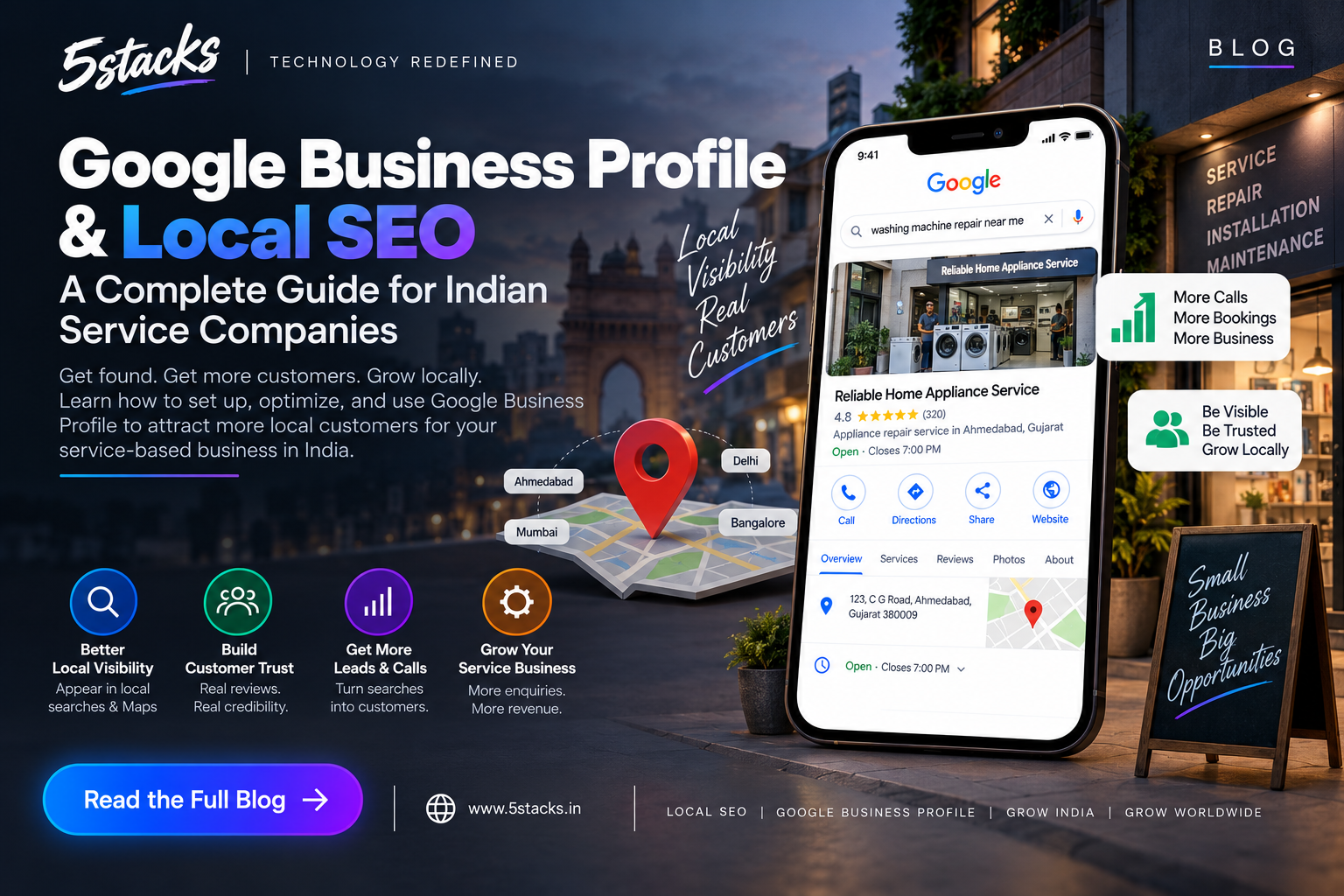
Google Business Profile and Local SEO for Indian Service Companies
City + service searches still convert. A visual playbook for GBP, reviews, NAP,...

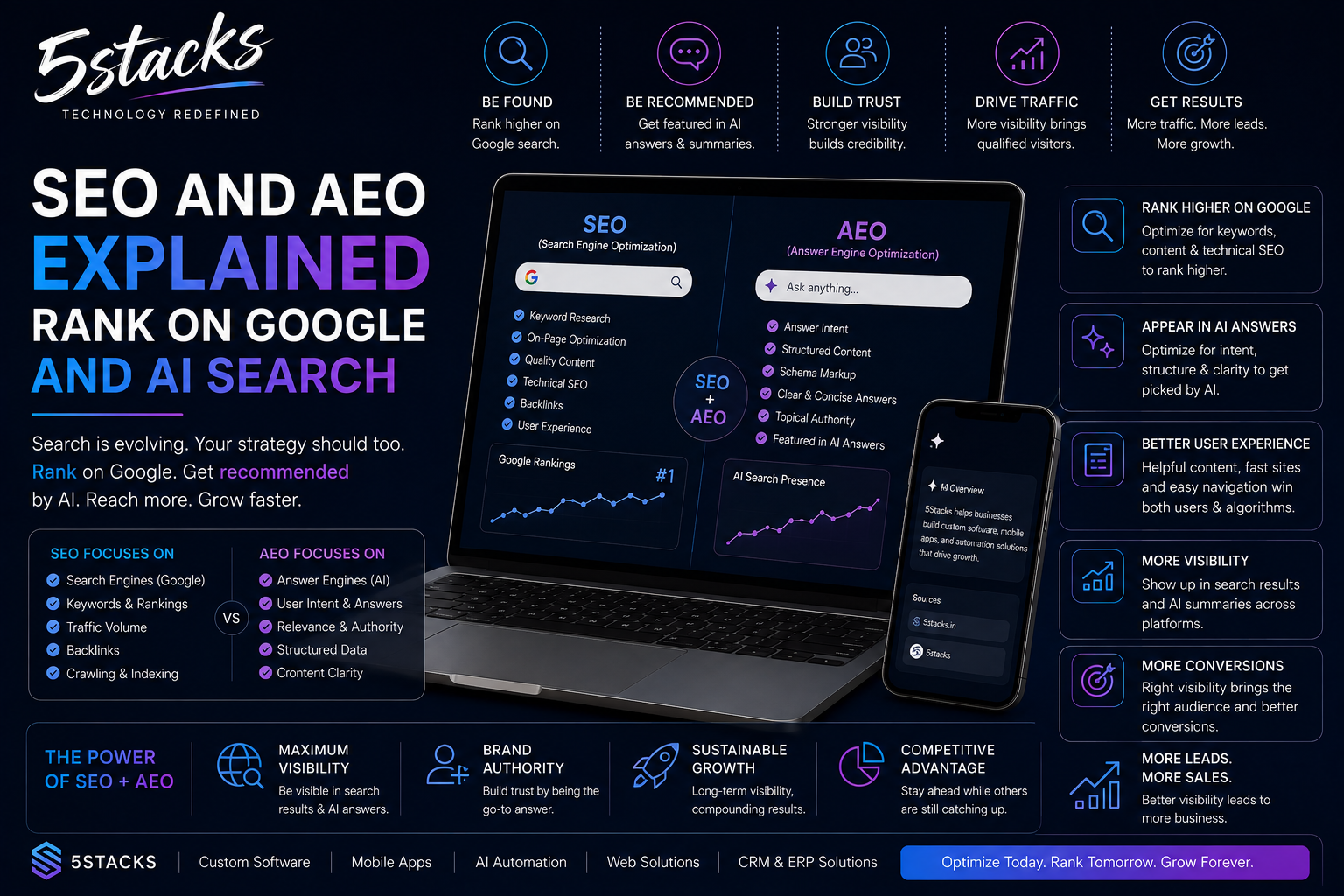
Search is no longer only ten blue links. Buyers still Google your service — and they also ask ChatGPT, Gemini, Perplexity, and Google AI Overviews for recommendations. SEO helps you rank in classic results. AEO (Answer / AI Engine Optimization) helps your brand get cited in AI-generated answers. For Indian B2B and service companies, you need both.
This guide is the plain-English version of what real SEO & AEO work includes — not a list of buzzwords. Use it to brief your team, audit your site, or decide what to fix first.
Search Engine Optimization is the craft of making your site clear, fast, and trustworthy so Google can match it to real search intent. It is not keyword stuffing. It is structure, content, and credibility over months — not overnight tricks.
Think of SEO in four layers. Most SMBs over-invest in one layer (usually “write more blogs”) and ignore the others.
| SEO layer | What it covers | Example for a service firm |
|---|---|---|
| Technical | Crawl, index, speed, mobile, HTTPS, sitemap | Clean URLs, Core Web Vitals, no soft-404s, GSC coverage clean |
| On-page | Titles, headings, internal links, intent match | Service page answers “what / who / outcome / proof” |
| Content | Guides, FAQs, case studies that earn attention | Blog + portfolio that people cite |
| Authority | Mentions, reviews, quality backlinks | Clutch, LinkedIn, partner sites, Google Business Profile |
If your technical foundation is broken, new content underperforms. If your service pages are vague (“We offer innovative solutions”), rankings struggle even when the site is fast. SEO is a system — not a single blog campaign.
AEO focuses on being understandable and citable by AI systems: clear answers, FAQs, entity-consistent brand info, and structured content. AI tools prefer pages that state facts cleanly — who you are, what you do, for whom, with proof.
Buyers use AI differently from Google. They often ask conversational questions: “Best CRM for a mid-size manufacturing company in Gujarat?” or “What should a website include for a B2B service company?” AI answers compress the web into a short brief. If your site never states those answers clearly, you are invisible in that layer of discovery.
Visual idea: Diagram — User question → Google SERP + AI Overview → Your page cited. Label left “SEO” and right “AEO”.
Write for humans first. AEO rewards clarity: definitions in one sentence, steps in numbered lists, comparisons in tables. That same clarity helps sales teams and improves classic SEO click-through rates.
AEO does not replace SEO. Thin pages that somehow “sound AI-friendly” still fail if Google cannot crawl or trust them. Strong technical SEO plus clear answer content is the combination that wins.
| Goal | SEO focus | AEO focus |
|---|---|---|
| Get discovered | Rankings + impressions | Mentions in AI answers |
| Win the click / citation | Title + meta + position | Clear snippet AI can quote |
| Build trust | Reviews, links, UX | Facts, FAQs, proof blocks |
| Convert | Landing page relevance | Consistent brand story everywhere |
Practically: fix crawl and titles first, then rewrite service pages so the first screen answers the query, then add FAQs and case studies, then pursue reputable mentions. Skipping to “AI SEO tools” while your service pages are empty is a waste of money.
Indian B2B and SMB buyers mix English and local context. Patterns we see often:
Your content should map to those intents. A blog that only explains theory without local proof or a clear next step underperforms. Link theory to a real service page and a real case study.
You do not need a 40-page strategy deck. You need a sequence.
| Days | Focus | Deliverables |
|---|---|---|
| 1–30 | Foundation | GSC cleanup, sitemap, titles/metas on top 10 URLs, speed fixes, NAP consistency |
| 31–60 | Answer quality | Rewrite 3–5 service pages, add FAQs, publish 2 deep guides, strengthen internal links |
| 61–90 | Proof + authority | 2 case studies, review asks, selective directory/partner mentions, measure CTR + queries |
Measure monthly: impressions, CTR, average position for target queries, and which pages get branded searches. For AEO, track whether AI tools mention your brand when you ask category questions (manual spot-checks are fine at SMB scale).
For service companies in India, the highest-ROI content is rarely a daily news blog. It is durable pages that match how buyers search and how AI systems summarise:
Every guide should link to one service URL and one proof piece. Orphan blogs waste crawl budget and sales attention.
Many firms sell locally (city/region) and nationally (remote delivery). Treat those as related but different intents. Strengthen Google Business Profile for local pack visibility; strengthen service depth and case studies for national queries.
Do not create thin doorway pages for dozens of cities you do not serve. One honest footprint plus excellent service pages beats fake geographic coverage.
Longer guides create linkable assets — not automatic links. After publish:
Avoid bought link packages. One relevant industry mention beats fifty junk directories.
Practical SMB stack: Search Console, Analytics, a query→URL tracker spreadsheet, mobile speed checks on money pages, and a monthly 90-minute review (coverage, CTR, gaps).
One improved service page per month plus one durable guide beats ten thin posts followed by silence.
5Stacks implements this stack for B2B and service brands — technical SEO, content, and AEO readiness. If you want a focused audit of your top service pages, book a call. Bring your Search Console access and the five queries that matter most to revenue.
Is AEO just another name for SEO?
How long until SEO results show?
Do I need separate pages for AEO?
Can small companies compete with big agencies on AEO?
Should we hire an SEO agency or do it in-house?
Are backlinks still important in 2026?
What should we fix first if budget is tight?