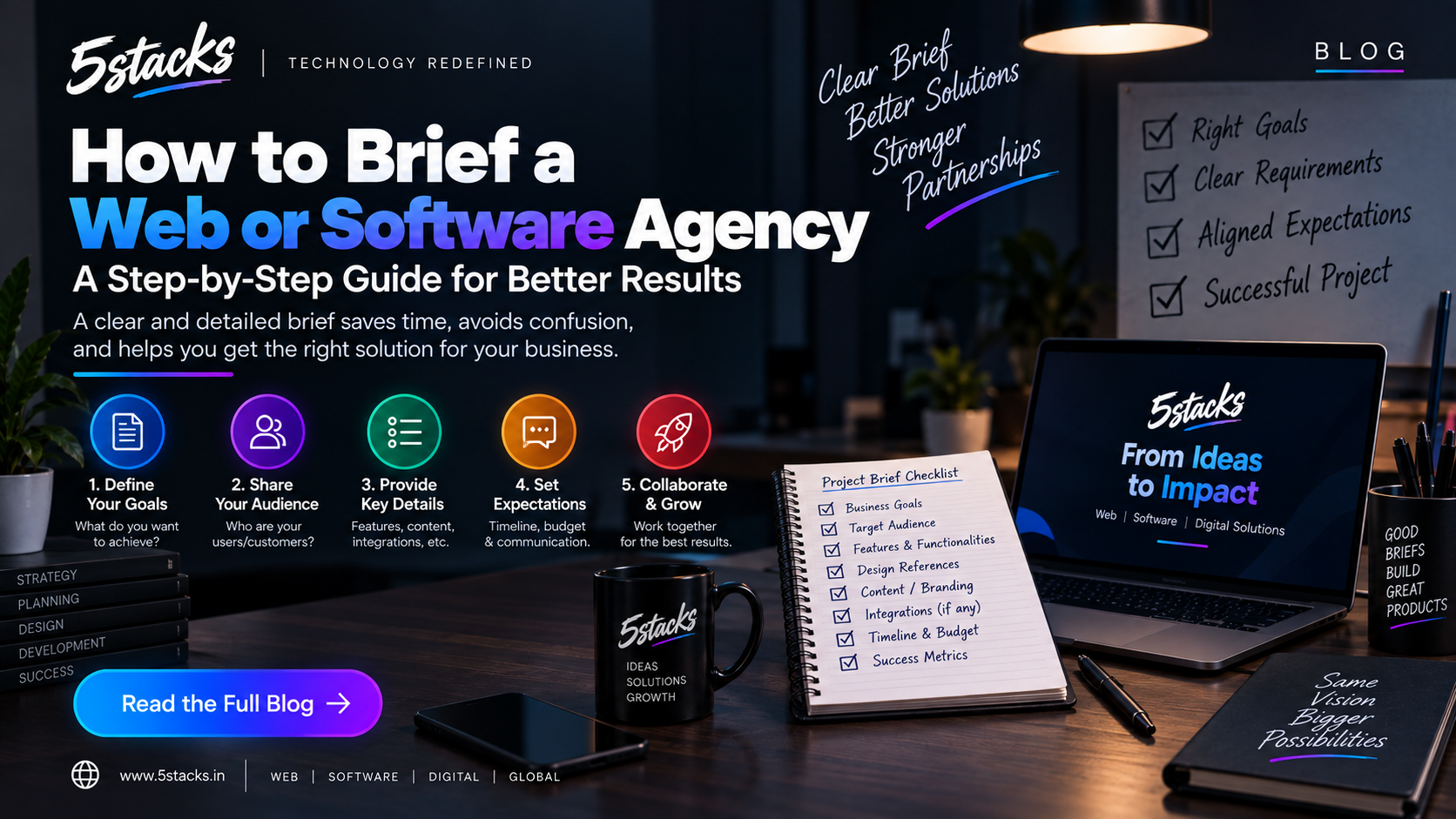
How to Brief a Web or Software Agency (So the Project Doesn’t Fail)
Most failed websites and software projects start with a vague brief. Use this In...
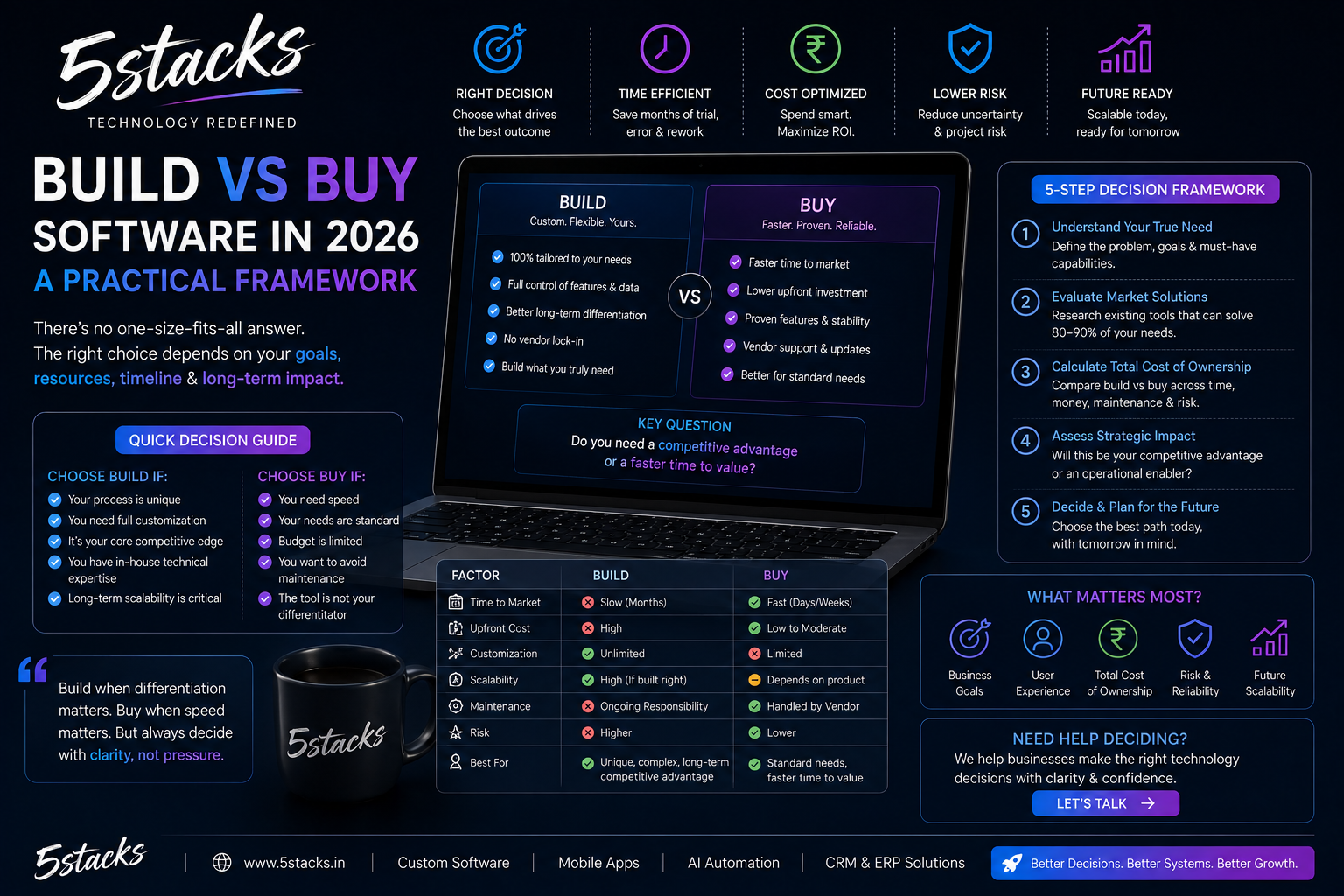
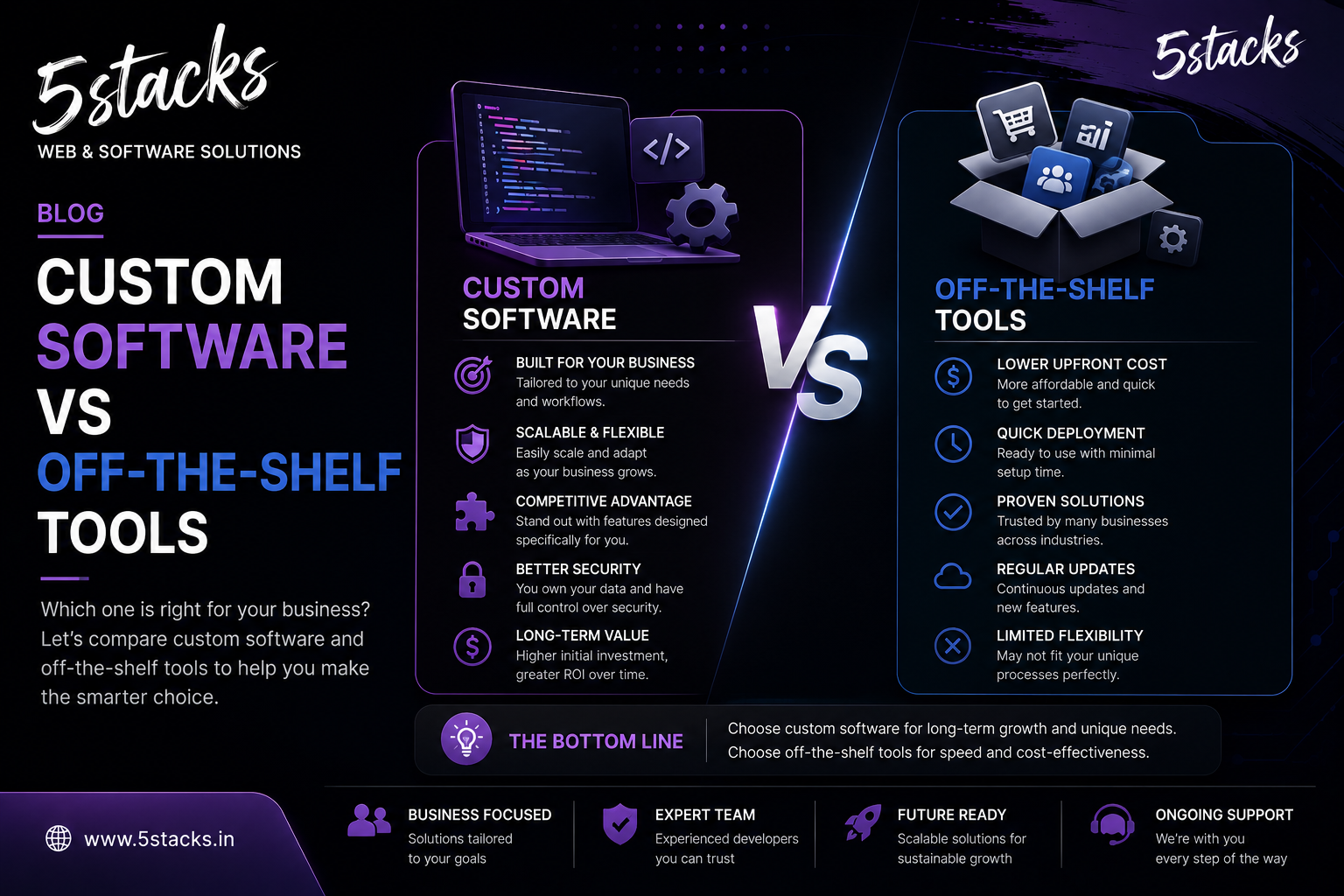
Every growing company hits the same fork: keep paying for ready-made tools, or invest in software that fits how you actually work. “Build vs buy” debates get loud because both sides are partly right. SaaS is faster to start. Custom software can become a competitive advantage — or an expensive hobby.
This framework helps founders and operations leads decide calmly. It is how we think about custom software development with Indian SMBs and mid-market teams.
Tools that felt fine at 10 people break at 40. Spreadsheets multiply. Staff invent workarounds in WhatsApp. Management reports take three days. At that point someone says “Let’s build an app,” while finance says “Just buy another subscription.”
Both impulses can be wrong. Buying more SaaS can create data silos. Building too early can freeze a half-understood process into code. The goal is fit: software that reduces manual work without trapping you.
Score each dimension honestly. If most answers point to “commodity,” buy. If most point to “advantage / constraint,” build (or heavily configure).
| Question | Lean buy | Lean build |
|---|---|---|
| Is the process unique to us? | No — industry standard | Yes — how we win deals / run ops |
| How often do workarounds fail? | Rarely | Weekly pain, lost money or trust |
| Do tools force bad process? | We can adapt | Tools fight our workflow |
| Data sensitivity / integrations | Simple exports enough | Deep ERP/CRM/API needs |
| Time to value | Need something this month | Can invest over a quarter+ |
| Who owns the process? | No clear owner | Ops/sales owner ready to decide |
No clear process owner? Do not build yet. Document the workflow first. Software cannot invent discipline.
Visual idea: 2×2 matrix — Process uniqueness vs Pain frequency. Top-right quadrant = strong custom candidate.
Compare three-year cost, not month one.
Custom is not automatically more expensive long term. Sum SaaS seats, duplicate data entry, and failed workarounds over 2–3 years. Many manufacturers and field-sales teams discover custom modules cost less than endless subscriptions that never fit.
Conversely, building a generic CRM from scratch when HubSpot/Zoho/etc. cover 90% of needs is usually a mistake.
Buy, configure, integrate lightly, and revisit in six months.
Look at real examples in our portfolio — refinery ERP, field sales apps, and ops platforms — where off-the-shelf tools left gaps.
Most sensible stacks are hybrid:
Own your data model for the spine. Exportability matters if you start on SaaS and migrate later.
| Phase | Goal | Outcome |
|---|---|---|
| 0 — Map | Document current workflow + pain | Shared process map |
| 1 — Slice | Automate one painful workflow | Working module in weeks, not years |
| 2 — Adopt | Train, measure, fix friction | Real usage data |
| 3 — Expand | Next module only if Phase 2 sticks | Compounding system |
Refuse big-bang “rebuild the company in one ERP” unless you have budget, change management, and executive sponsorship. Phased delivery protects cash and morale.
Ask the same questions whether you buy SaaS or hire a dev shop:
Red flags: vague timelines, no references, unwillingness to phase scope, or “we’ll figure it out in development.”
Run a 90-minute workshop: list pains with evidence, map the workflow, mark unique vs commodity steps, agree 90-day success metrics, decide buy/build/hybrid in writing. Reopen the debate without a record and you burn cash and morale.
Almost every SaaS purchase becomes integration: GST, payments, WhatsApp, email, legacy inventory. Count integration effort in the buy column. When advantage lives between systems, custom glue or a custom spine often wins.
Buy: standard leave/expense/CRM for a 25-person services firm. Build: quoting with regional commission rules SaaS cannot model. Hybrid: SaaS accounting + custom ops ERP for stock states accounting cannot handle.
Score each row 1–5 (1 = strong buy, 5 = strong build). Add notes. Total above 35? Lean build for that workflow.
| Factor | Score 1–5 | Notes |
|---|---|---|
| Process uniqueness | ||
| Integration depth needed | ||
| Change frequency | ||
| Data sensitivity | ||
| Time to value pressure | ||
| Internal ownership capacity | ||
| Competitive advantage if custom |
Re-score quarterly. What was “buy” at 10 employees may become “build” at 80.
Whether you buy SaaS or build custom, read the boring pages. That is where lock-in lives.
If you are stuck between another SaaS seat and a custom module, bring your process map to a call. 5Stacks can help you choose the cheaper honest path — including “don’t build yet.”
Is custom always more expensive long term?
Can we start on SaaS and migrate later?
Who owns the code if 5Stacks builds it?
How do we avoid overbuilding?
When is no-code enough?
How long does a first custom module take?
Should we hire developers in-house?