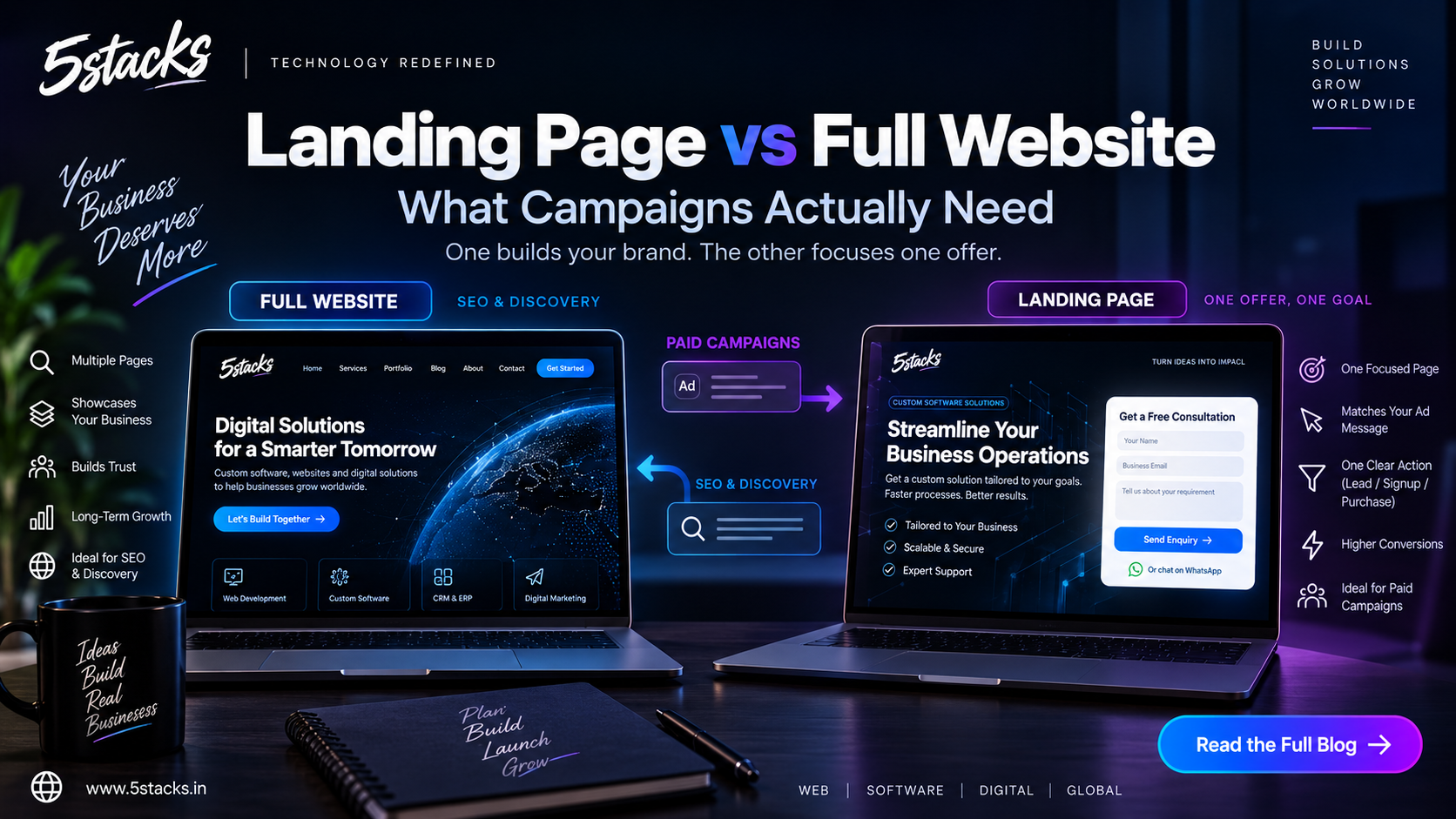
Landing Page vs Full Website: What Your Campaign Actually Needs
Ads fail when they dump people on a busy homepage. Visual guide: when to use a l...

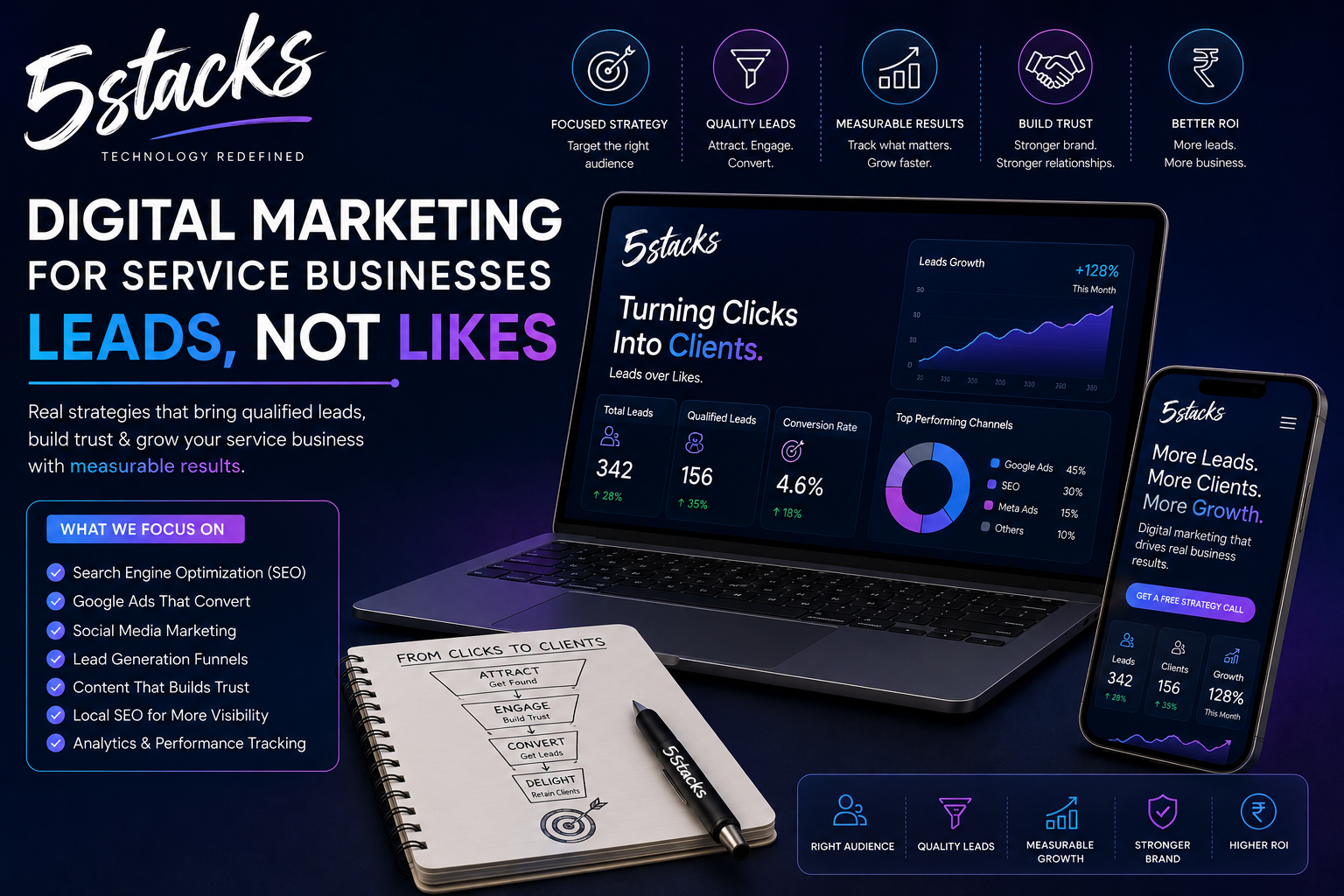
If your marketing report celebrates reach and likes while the sales calendar is empty, you do not have a marketing problem — you have a definition problem. Service businesses win when marketing buys conversations with the right buyers.
This playbook is how we think about digital marketing services for consultancies, agencies, manufacturers with service arms, and B2B firms in India.
Social proof helps. Vanity metrics mislead. A viral reel does not equal qualified demand for a ₹5L+ engagement. Optimise for:
Likes are a side effect when content is useful. They are not the KPI.
Visual idea: Funnel — Impressions → Profile visits → Landing page → Enquiry → Sales call. Highlight where most teams stop measuring (too early).
| Channel | Best for | Weak when… |
|---|---|---|
| Google Search / SEO | High-intent “hire / cost / near me” queries | You have no clear service pages |
| Google Ads | Fast tests of offers + geo | Landing page is weak |
| B2B trust + thought leadership | You post slogans, not proof | |
| Meta ads | Local services, visual offers | Buyer is purely LinkedIn/search |
| Email / WhatsApp nurture | Warm follow-up | No CRM hygiene |
Match channel to buyer. Do not run Meta ads because a cousin’s salon got likes.
Weak offer: “We are a leading digital agency.” Stronger offers:
Give a reason to talk this week — not a brochure dump.
Ads and posts should land on pages that:
Pair marketing with a converting site — see our notes on websites that convert and web development.
If leads are junk, fix targeting and offer before raising budget. If leads are good but closes fail, that is sales process — not “marketing is broken.”
| Days | Build | Output |
|---|---|---|
| 1–30 | Offer + landing page + tracking + CRM fields | Measurement baseline |
| 31–60 | One paid channel test + 4 proof posts / month | First qualified pipeline |
| 61–90 | Double down on winners; kill losers; SEO compounding | Repeatable monthly system |
Consistency beats volume. Three strong proof posts beat fourteen empty slogans.
Bring partners when you lack time for creative + tracking + iteration, or when paid spend needs specialist eyes. Keep strategy ownership in-house: ICP, offer, and sales follow-up SLAs.
Small consistent rhythm beats quarterly campaign bursts that fade.
Define ideal customer profile in one paragraph: industry, company size, geography, budget band, trigger event (new plant, rebrand, CRM pain). Ads without ICP attract cheap clicks and expensive sales time.
Publish proof-led content monthly: case study angles, process explainers, comparison posts, and FAQs from sales calls. Each piece links to a service page and Contact — not only social vanity.
Marketing is wasted if sales responds in five days. Agree SLA: first response within one business day, qualification questions documented, CRM stage updates mandatory.
Many SMBs start 60% on one proven channel test, 30% on content/SEO compounding, 10% on experiments — adjust quarterly based on cost per qualified conversation, not impressions.
Minimum fields for attribution: source, campaign, landing page, enquiry type, qualification status, lost reason. Without them, you cannot answer “which channel bought good leads?” — only “how many forms.”
Train sales to update stages weekly. Marketing without CRM hygiene is guesswork.
Google Search: Money pages + FAQs + proof. Track queries with impressions in Search Console; rewrite titles when CTR is weak.
LinkedIn: Founder/company posts with one insight + one proof point + link. Comment on ICP conversations — do not only broadcast.
Meta (local services): Simple offer + landing page + call/WhatsApp CTA. Kill ads that produce junk leads fast.
Email/WhatsApp nurture: Short follow-ups for warm leads who did not book — not weekly newsletters nobody opens.
Run one channel well before spreading budget across five.
Examples of marketing + web work live in our portfolio. Ready to stop optimising for applause? Talk to 5Stacks about a lead system tied to real pipeline.
How fast do ads produce leads?
Should every business run Meta ads?
What is a good CAC for services?
Do we need daily posting?
SEO or ads first?
How many leads are “enough”?
Can content marketing work for local service businesses?