
Case study
Refinery & Precious-Metal Operations Platform
Industry: Precious-metal refining, trading & minting · Focus: Traceability, vault integrity, assay trust, faster settlements
The problem refineries actually face
Most refining businesses do not fail because they lack buyers or furnaces. They lose money in the gaps: handwritten inward notes, purity arguments with vendors, metal sitting “somewhere,” salespeople carrying stock with no clear accountability, and managers who only discover shortages at month-end.
In a metal business, grams are cash. When weight, purity, person, and document are not linked, you get disputes, write-offs, and weak negotiations.
| Area | What goes wrong | Business impact |
|---|---|---|
| Purchase / inward | Vendor weight and purity recorded inconsistently; reports missing or informal | Overpayment, weak vendor leverage, hard-to-defend books |
| Laboratory / assay | Touch results live in separate sheets; not tied to the original purchase lot | Re-work, delayed refining, trust gaps |
| Refining & re-weigh | Before/after metal not reconciled in one chain | Unexplained process loss, unclear yield |
| Vault / strong-room | Locker stock, “with salesperson,” and “in production” mixed mentally | Leakage risk, slow audits, blame without evidence |
| Minting | Piece planning, serials, QC, packaging tracked in chats or Excel | Wrong counts, serial clashes, delayed finished goods |
| Sales & settlements | Staff sell or hand metal without a closed stock story | Credit disputes, open stock after “sale” |
What we provided
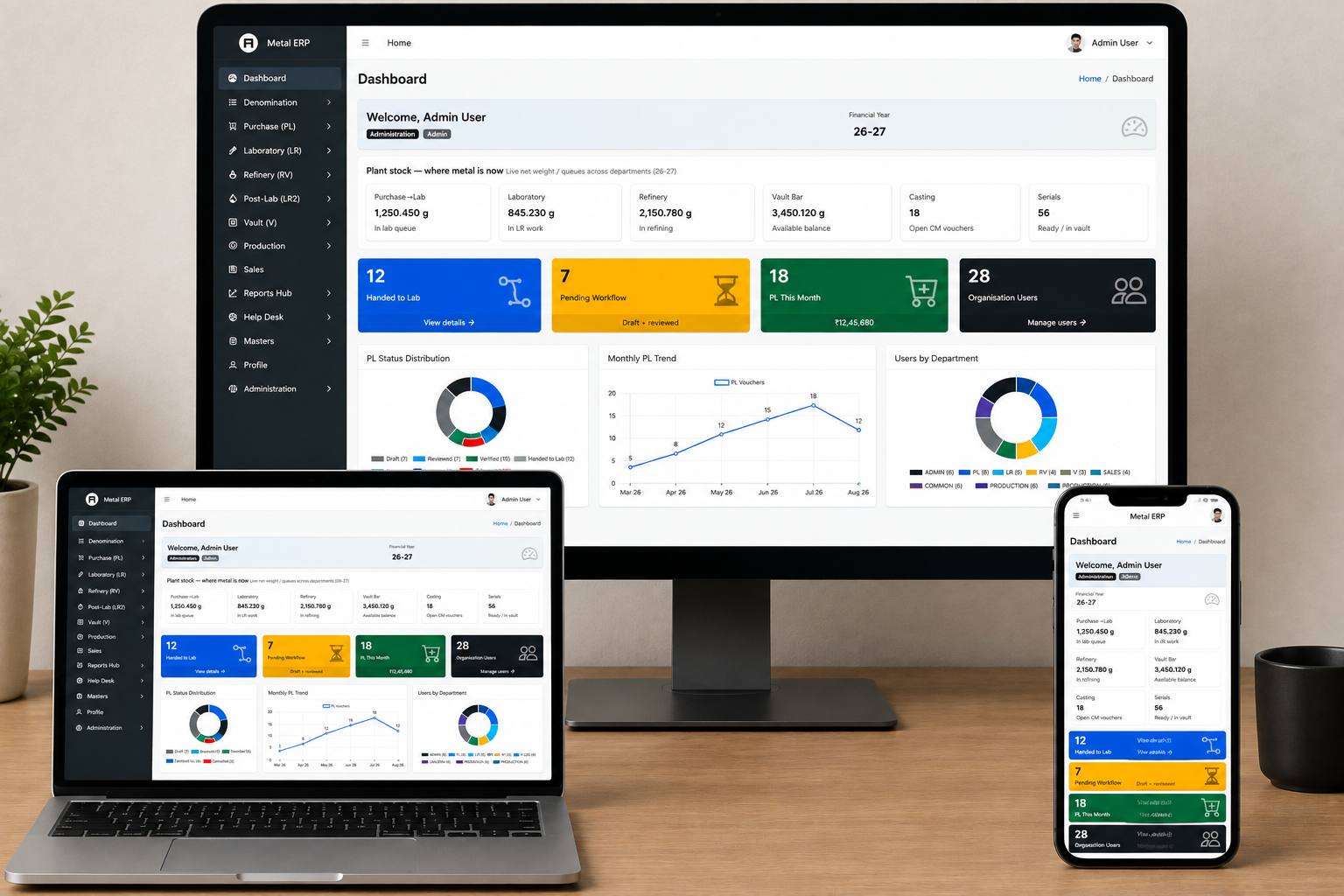
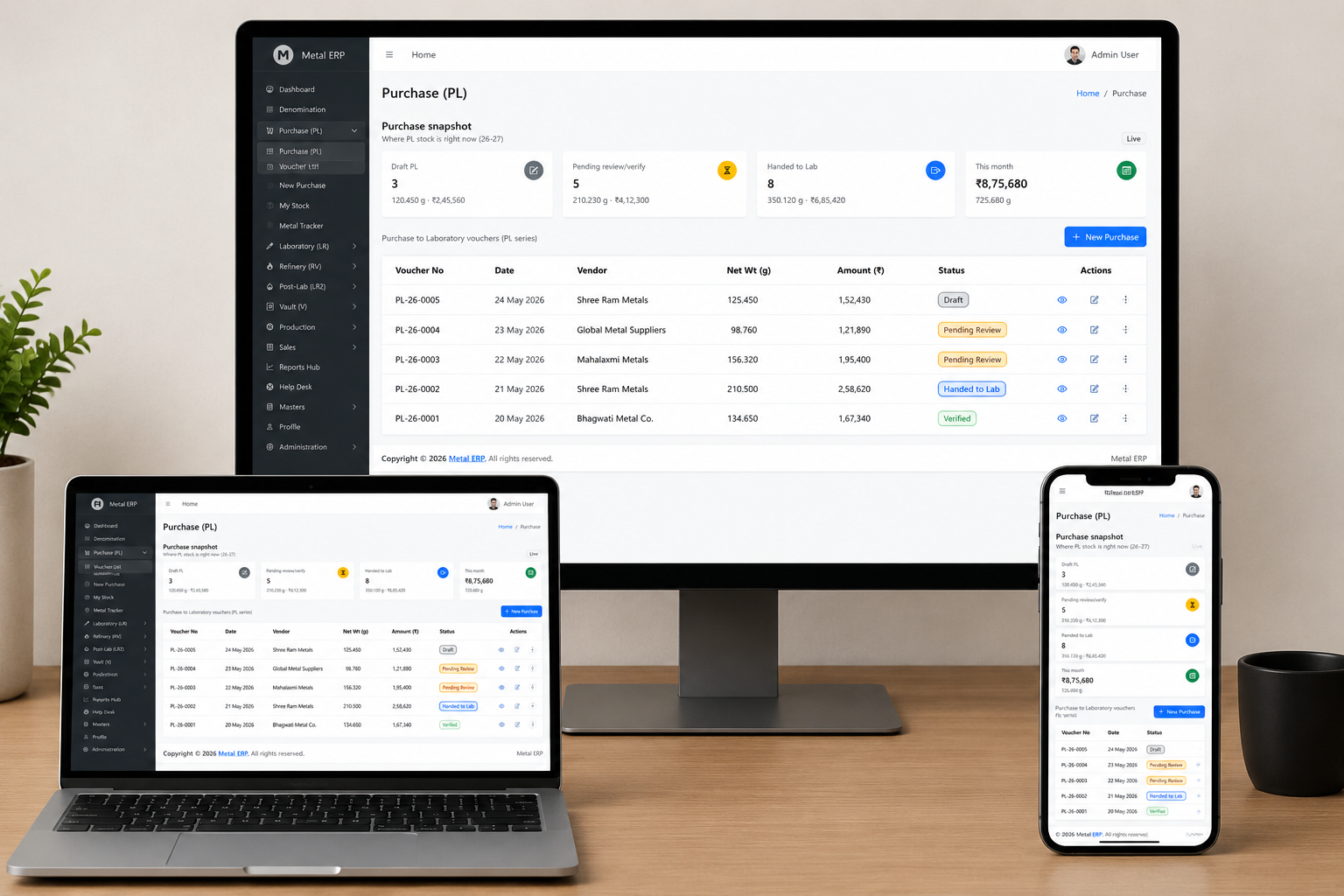
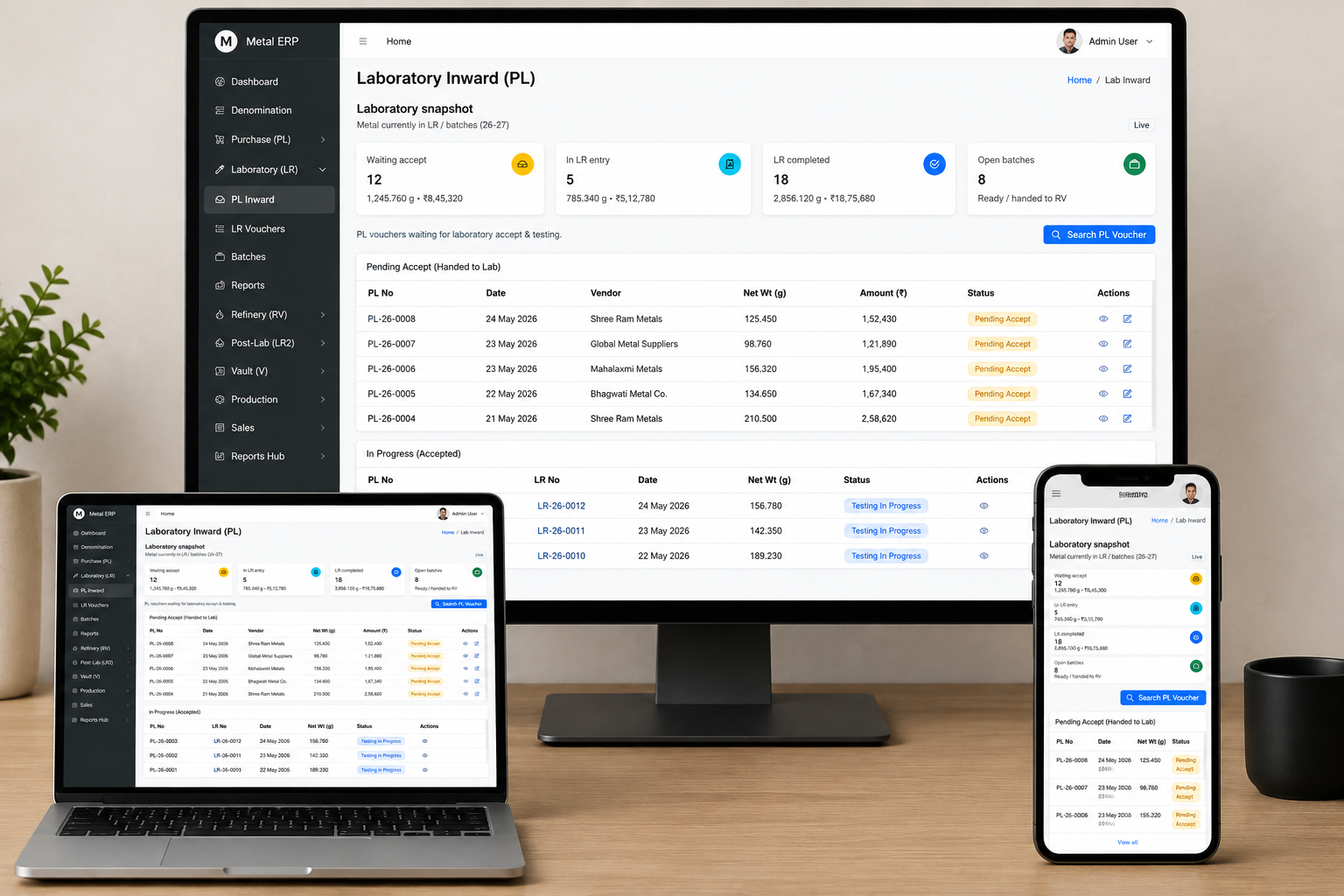
We designed and delivered a department-aware operations platform for refining and trading houses: role-based access, voucher-driven workflows, purity-aware calculations, vault-centric stock, serial-level finished goods, and monitoring for who holds which metal.
- Single source of truth: metal is in the vault, with a named person, in production, sold, or settled—never “somewhere.”
- Assay-linked commercial records: purchase and lab thinking stay connected.
- Vault as control hub: refined and minted metal becomes accountable inventory before sale or further issue.
- People-held stock: field teams carry assigned pieces with clear settlement paths.
- Serial intelligence: finished pieces are searchable for location, holder, and sold status.
- Operational locks: history cannot be casually rewritten after key steps.
| Industry pain | Capability delivered | Why it matters |
|---|---|---|
| “Where is this metal?” | Stock views + serial monitoring (locker / person / sold) | Faster audits, fewer arguments |
| Purity fights with vendors | Structured purchase & lab records with % purity math | Defendable commercial decisions |
| Informal staff stock | Vault credit to named users; settle on sale or return | Accountability without stopping field work |
| Minting chaos | Demand-driven production into vault-accepted pieces | Predictable finished-goods inflow |
| Month-end spreadsheet merge | Department documents, reports, role dashboards | Visibility in operating time—not only closing time |
Conceptual operating model
A public, portfolio-safe view of how refining operations need information to move when software is designed correctly—not an internal runbook.
Conceptual model for buyers and operators — private system URLs and internal runbooks omitted.
| Stage | Control question |
|---|---|
| Inbound | What did we buy, at what declared purity, under which document? |
| Assay / process | What did we measure, and how does that change commercial truth? |
| Vault | What is physically secured right now? |
| People stock | Who is holding which pieces, and why? |
| Outbound | Was it sold, returned, or settled—cleanly? |
Desk math teams already trust
For finished serialized pieces, commercial lines should respect the piece’s established net—not invent a new weight by casually re-applying purity. That protects both margin and customer trust.
Who benefits
- Owners: fewer unexplained losses; clearer yield and stock posture
- Vault managers: locker vs person-held metal separation
- Purchase & sales teams: assigned stock they can work with
- Lab & production leads: less chat coordination, more document continuity
- Accounts / auditors: voucher trails instead of reconstructed stories
Delivery approach
Built as a modern web application with role-based permissions, department dashboards, printable documents, and operational reports. Implementation used real desk language—vouchers, purity%, vault, serials—rather than generic warehouse SKU software that ignores how metal businesses think. Stack direction: Laravel-based backend, structured masters, permissioned modules, operator-first UI.
Outcomes
- Replaced fragmented sheets with a controlled metal operations spine
- Made vault the mandatory control point after refining / minting inflows
- Enabled accountable field stock: issue → hold → sell / settle
- Introduced serial-level monitoring for finished goods
- Aligned commercial math with industry desk conventions
Client metrics, private URLs, credentials, and internal runbooks are omitted from this public case study.
Frequently Asked Questions
What software do refineries need beyond accounting?
Why is a vault module critical?
How do sales teams carry metal safely?
Is this the same as generic ERP inventory?